












From BMS to Inverters: How Do Solid State Discrete Devices Empower Portable Energy Storage Across All Scenarios?
AC-DC Charging: High-Efficiency Fast Charging, Stable Conversion
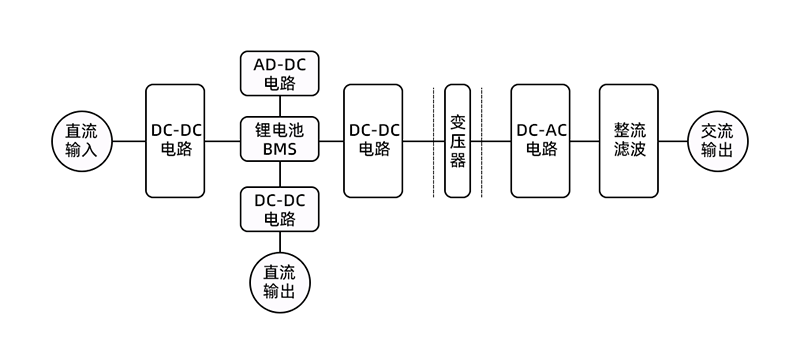
This module converts commercial AC power into DC power to provide stable charging energy for battery packs. Its circuit topology is similar to that of PD switching power supplies and commonly employs fast-charging solutions.
We recommend using Gooder-Walker high-voltage SGT MOSFETs and super-junction MOSFETs, which feature low on-resistance, high voltage withstand, and high-frequency response, significantly improving charging efficiency and thermal reliability. Combined with discrete components such as fast-recovery diodes and bridge rectifiers, these solutions further optimize the system’s EMI performance and conversion stability.
PART.02
BMS Lithium-Ion Battery Protection: Safeguarding Cells, Safety First
Energy storage systems typically use lithium-ion batteries, usually configured with multiple cells of ternary lithium or lithium iron phosphate arranged in parallel and series. System voltages include 12V, 24V, 36V, 48V, and other options. The BMS manages battery charging and discharging, as well as protection against overcharging, over-discharging, overcurrent, short circuits, and high temperatures, placing extremely high demands on the MOSFET’s overcurrent capacity and short-circuit resistance.
We recommend using the GoodWalk 30V–100V Trench & SGT MOSFET series as the main switching devices for charging and discharging. These MOSFETs support high continuous current and strong surge tolerance, ensuring rapid response and reliable disconnection in multi-series-parallel configurations. Combined with precision voltage regulators, low-dropout Schottky diodes, and other components, they form a complete battery protection chain.
PART.03
DC-DC Buck-Boost: Multi-output, High Efficiency Without Frequency Reduction
This module converts battery DC power into multi-level outputs of 5V, 9V, 12V, 15V, and 20V to support simultaneous multi-port output for Type-C, USB, car chargers, and DC ports, with a particular focus on the high-frequency switching characteristics and free-wheeling efficiency of the MOSFET.
We recommend using the SolidWorks SGT MOSFET series, which offers low gate drive current and low switching losses in the medium-to-low voltage range. Combined with high-efficiency Schottky diodes and zener diodes, this solution maintains low heat generation and high conversion efficiency during high-frequency operation, enabling compact and highly integrated designs for multi-port output systems.
PART.04
DC-AC Inverter: Hardcore Assurance of Pure Sine Waves
In the DC-AC inverter section, boosting the battery’s DC voltage to convert it into 220V/110V household AC power is the key to enabling “appliance freedom” for outdoor power supplies. The inverter circuit imposes stringent requirements on MOSFETs regarding on-resistance, gate charge, and EMI compatibility.
We recommend using the GoodWalk high-voltage SGT MOSFET series, which optimizes switching characteristics while ensuring low dynamic losses, effectively reducing electromagnetic interference, and meeting the stable power supply requirements of common household appliances. Pairing this with GoodWalk’s fast-recovery diodes—used for buffering and absorbing spikes to protect power transistors—further enhances the system’s overall reliability and shock resistance.
PART.05
Why Choose GoodWalk?
In the portable energy storage sector, where technology evolves rapidly and competition intensifies, selecting a stable and reliable component partner is key to a product’s market success. Leveraging its deep expertise and comprehensive portfolio in discrete devices, GoodWalk provides energy storage customers with highly compatible, reliable, and one-stop discrete device solutions. This simplifies R&D processes, reduces BOM costs, and enhances the core competitive advantages of their products.
In terms of core functionality, Godewalker’s discrete components each fulfill specific roles with high compatibility: N-MOS/PMOS handle switching control for charging, discharging, inverting, and buck-boost operations, ensuring efficient circuit operation through low on-resistance and high-speed switching characteristics; Schottky diodes enable rectification, current continuation, and reverse-connection protection, reducing power loss and heat generation; ultra-fast recovery diodes are optimized for high-frequency applications, enabling precise high-frequency rectification and spike absorption while withstanding voltage surges; TVS/ESD protection devices fortify interface security, effectively suppressing various electromagnetic interferences such as surges, static electricity, and lightning strikes, and providing comprehensive protection for downstream circuits.
Conclusion
With the explosive growth in demand for outdoor power, portable energy storage is evolving toward higher power, lighter weight, faster charging, greater intelligence, and enhanced safety. Leveraging a comprehensive discrete device ecosystem, a stable supply chain, and localized technical support, GoodWalk provides energy storage customers with complete product solutions ranging from MOSFETs and diodes to TVS/ESD devices.
From solution design, component selection, and testing and validation to mass production and delivery, GoodWalk accompanies customers every step of the way, helping them create portable energy storage products that are more efficient, have longer battery life, are safer, and are more competitive. Amid the trend toward domestic substitution, GoodWalk has become the preferred partner for discrete components in the portable energy storage sector.